
Land, Harvest, Compound: The Forward-Deployed Framework for a Team of One
Land, Harvest, Compound — the forward-deployed framework for a team of one, and the harvest discipline that turns services work into a moat instead of an agency.

The giants run forward deployment with six-thousand-person orgs and 45-day pods. Here's the version built for a founder and an AI — a three-move framework that turns each customer deployment into the next one's head start, and the discipline that keeps you from accidentally becoming an agency.
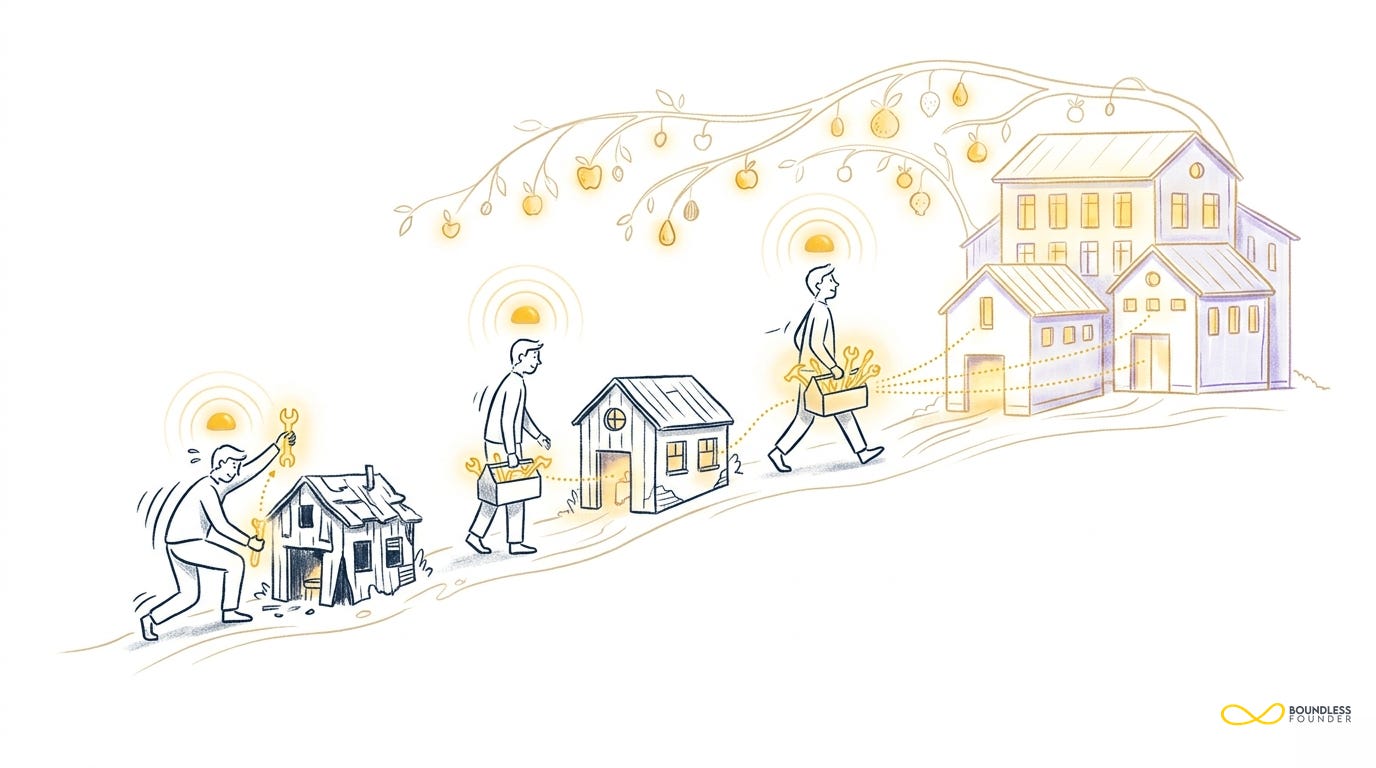
Last week I made the argument that the most important signal in AI right now is $9 billion of checkbooks pointed at deployment — and that the motion the giants are paying billions to staff is suddenly runnable by one founder with AI in the loop. I ended by naming that person: the forward-deployed founder.
The reply I got most often was some version of: okay — but what do I actually do on Monday?
Fair. Knowing the moment exists is not the same as knowing how to run it. And this is a motion with a famous failure mode. Get it wrong and you don't build a startup at all — you build a busy, cash-flow-positive, permanently stuck consultancy. a16z's essay on services-led growth is blunt about what happens to companies that copy only the embedded-engineer half of the playbook: they end up with thousands of bespoke, unmaintainable deployments and no moat. The deployment part is easy to imitate. The part that makes it a company is a discipline, and almost nobody names it.
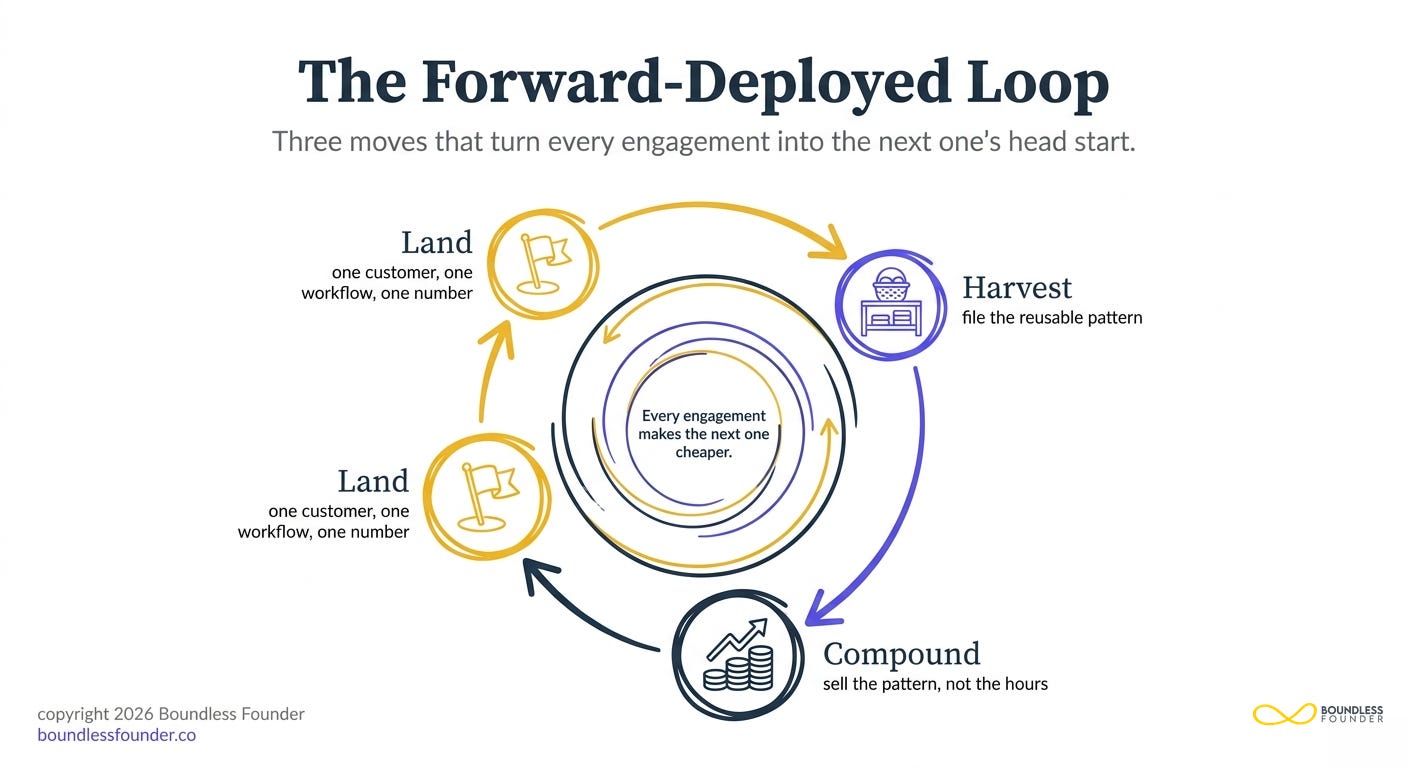
So this article names it. The framework is three moves — Land, Harvest, Compound — and the whole thing hangs on the middle one.
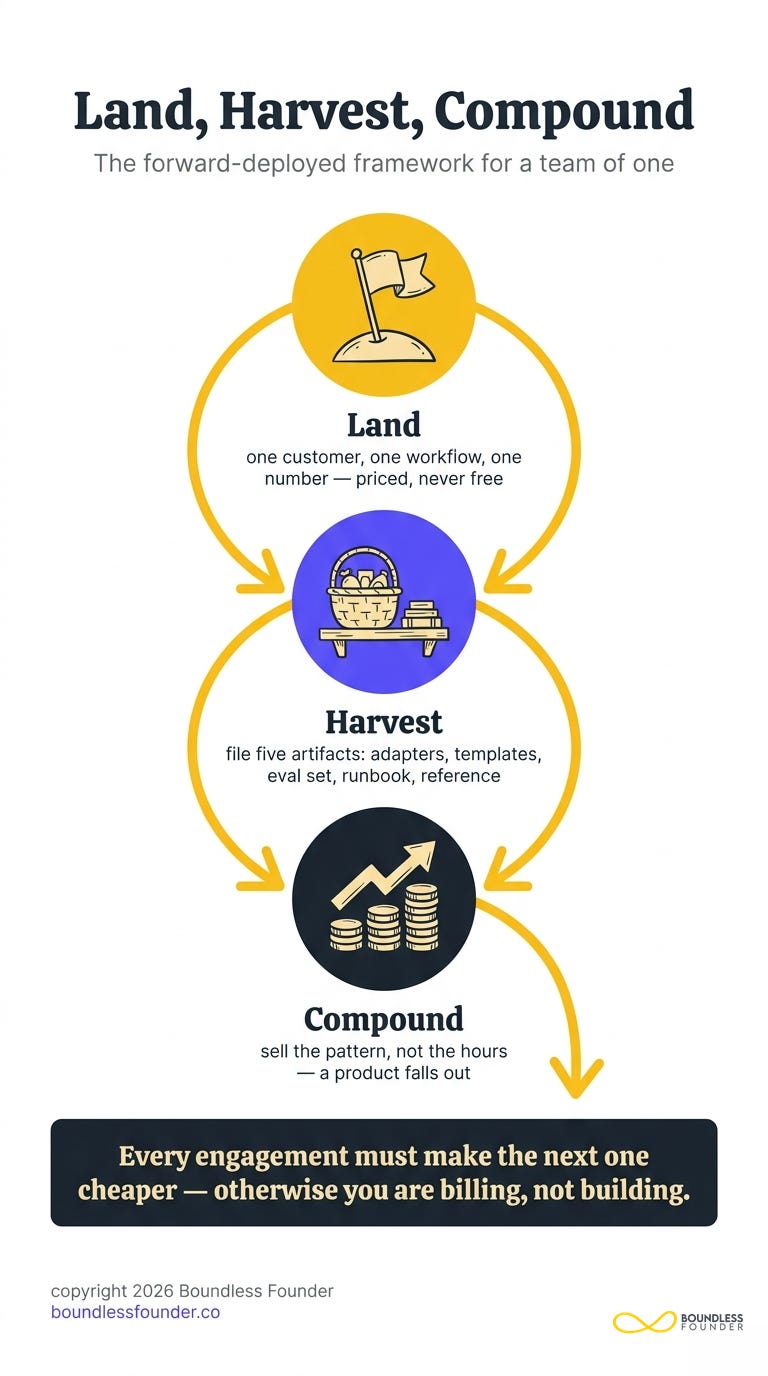
Land is a small, priced, tightly-scoped deployment inside one real customer's ugliest workflow. Harvest is the ritual that turns what you just built into reusable assets — the step that separates a moat from an agency. Compound is selling the pattern instead of the hours, so every deployment makes the next one faster, cheaper, and more credible. Run the loop enough times and a product falls out of it — which is exactly how the companies that perfected this motion did it.
The law the whole framework enforces
Before the mechanics, you need to feel the gravity the framework exists to fight — because it will pull on you from the first engagement.
Services revenue is seductive. It arrives fast, it doesn't require product-market fit, and every incentive in the engagement pushes you toward doing more of it: the customer is happy, they ask for the next thing, and saying yes pays this month's bills. This is why the default trajectory of "founder doing deployments" is an agency. Nobody decides to become one. They just say yes in sequence, and each yes is locally rational.
The companies that escaped that gravity all ran the same counterintuitive discipline. Palantir — the origin of this entire motion — priced its field work near cost and treated it as the wedge, then folded what its engineers learned into software that now carries roughly 81% gross margins. Professional services fell from about a quarter of its revenue to under a fifth as the mix tipped toward product — while individual accounts expanded three-to-four-fold. The engineers in the field weren't the business. They were the sensor that fed the business.
And if you look closely at the billion-dollar deployment orgs from Part 1, the public reporting shows them all running some version of the same loop at enterprise scale: land a first lighthouse deployment, turn what it proves into patterns that replicate across similar customers at falling cost, and leave the customer owning a capability rather than renting a vendor forever. The names differ; the loop doesn't. Land, Harvest, Compound is that loop shrunk to a bench of one — with AI standing in for the pod.
Here's the same idea, compressed into the one sentence this entire series stands on:
Every engagement must make the next one cheaper. If it doesn't, you're billing — not building.
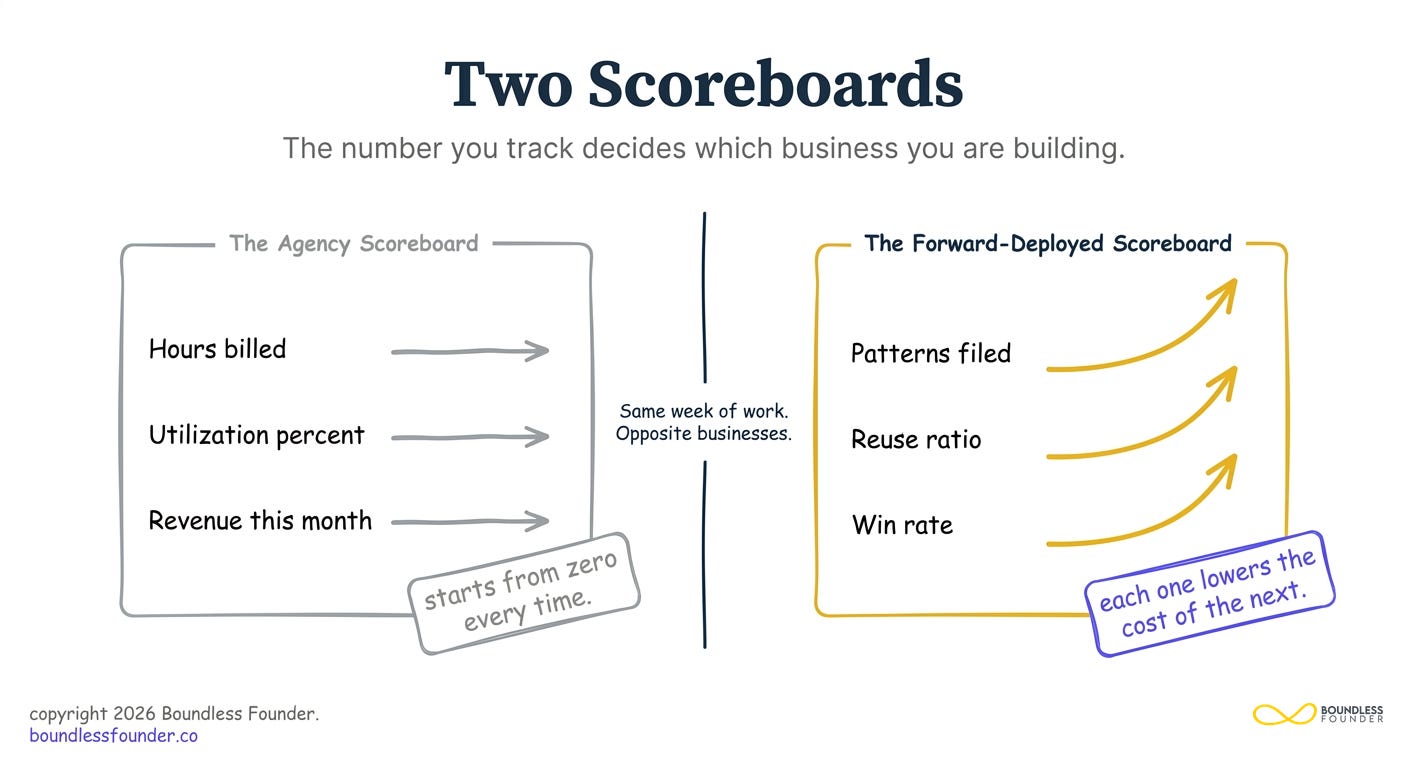
That's the law. An agency's engagements are independent events — each one starts from zero and earns only its fee. A forward-deployed founder's engagements are compounding events — each one leaves behind assets that lower the cost and raise the win-rate of the next. The difference isn't visible in this month's revenue. It's the only thing visible in year two.
Watch your own dashboard for the tell. If the number you track is hours billed and utilization, you're running an agency scoreboard. The forward-deployed scoreboard is what got filed in the library this month — and it's the harder one to care about, because nobody pays you for it directly.
The rest of this article is the operating manual for the three moves — how to pick and price the first land, the exact harvest ritual with its five artifacts, the compounding economics, the guardrails for when to say no, and a day-by-day playbook for your first ten-day sprint.
Land: one customer, one workflow, one number
The land is not a sale in the traditional sense. It's a paid learning expedition with a working system as the receipt. You are buying three things with your discounted effort — learning, a reference, and the seed of a pattern — and the customer is buying a result. Both sides get a bargain. That's what makes it land.
To keep this from floating in the abstract, let me run one concrete thread through the whole framework. Say your segment is regional commercial-insurance brokerages, and the workflow is quote intake: every inbound request arrives as a PDF-and-email mess, a producer retypes it into two systems, and quotes go out in days — in a business where the broker who answers in hours wins the account. A painful workflow, a number everyone already tracks (turnaround time), and a segment with hundreds of near-identical siblings. Any vertical with those three properties works; this one's ours for the rest of the piece.
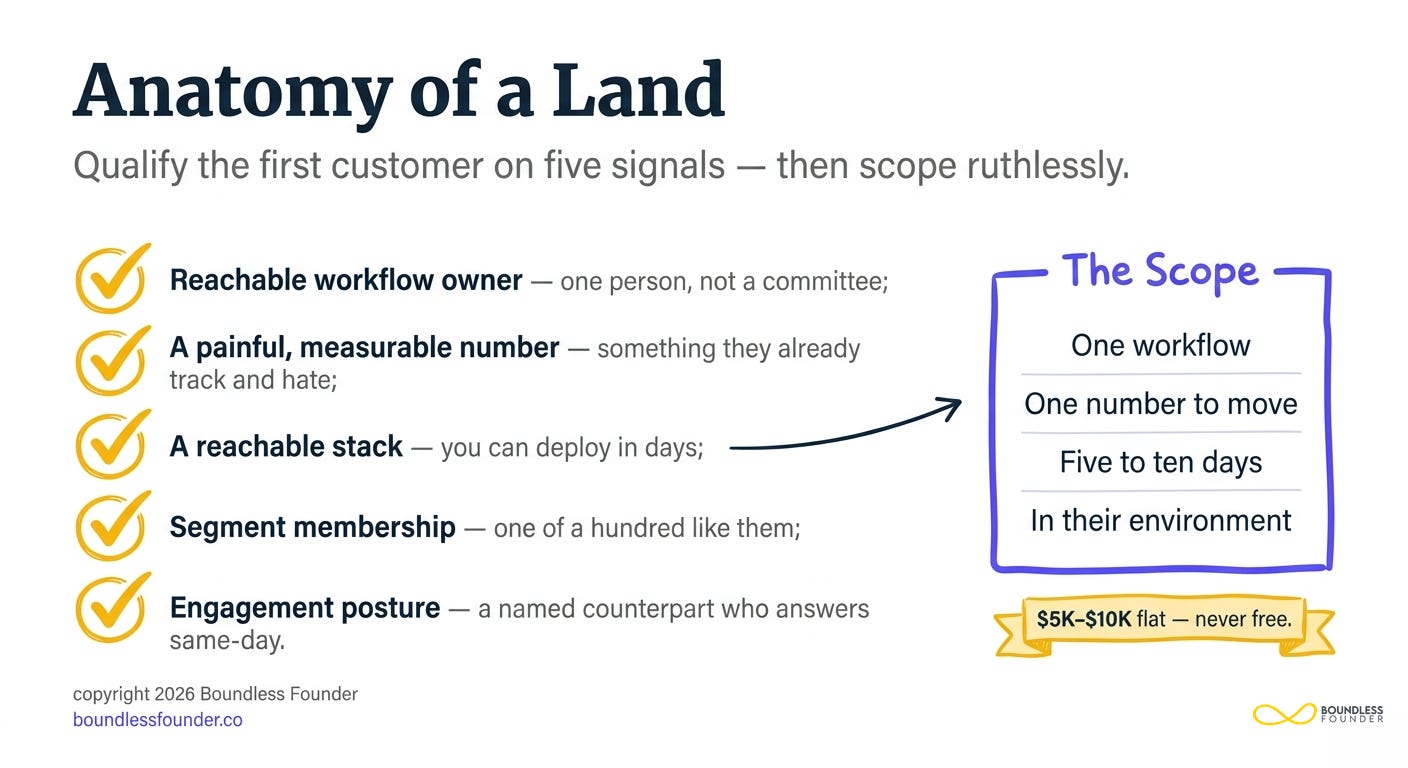
Picking the customer matters more than closing them. The wrong first customer costs you a month and teaches you nothing repeatable. Qualify on five observable signals:
The first is a reachable workflow owner — you can talk directly to the person who lives in the workflow daily and has the authority to change it. If every conversation routes through a committee, the deployment will die in scheduling before it dies of anything technical.
Second, a painful, measurable number. The workflow must have a metric someone already tracks and hates — hours per week, error rate, backlog age, cost per ticket. If they can't name the number, you can't prove you moved it, and an unproven land produces no reference and no pattern worth filing. This is the pre-commitment lesson from the enterprise data: MIT found projects with clear success metrics agreed before the pilot succeeded 54% of the time versus 12% without. Define the number before you write a line of code.
Third, a reachable stack — you can actually deploy into their environment in days: they can grant access, there's an API or an export, the data exists. One honest hour of technical reconnaissance (this is what AI is for — have Claude or GPT map their tools and sketch the integration before you commit) beats discovering a compliance wall on day four.
Fourth — and this is the one founders skip — segment membership. Your first customer should be one of many like them: the same workflow, the same tools, the same pain, repeated across an industry niche. A fascinating one-off customer is a trap; whatever you build for them proves nothing about anyone else. The whole framework runs on patterns transferring across similar customers, so pick the customer who has a hundred siblings.
Fifth, engagement posture. They'll name a counterpart, share real data, and answer questions same-day during the sprint. A customer who wants to "see what you come up with" from a distance is a tourist, and tourist pilots are where enterprise AI goes to die — 95% of them, by MIT's count.
The offer is one sentence. You saw it at the end of Part 1: give me your ugliest workflow and one week — I'll rebuild it, working, in your environment, for a flat price, and you keep what I build either way. Every clause is load-bearing. Ugliest workflow selects for real pain. One week makes the ask small enough to say yes to without procurement. Working in your environment is the difference between a demo and a deployment. Flat price kills scope anxiety. You keep it either way removes the last excuse — and costs you nothing, because the thing you're keeping is the pattern, not the code.
Price it small, but never free. The founder-sized version of this engagement is running at $5,000–$10,000 in ten-day sprints — a tier that exists precisely because the enterprise version doesn't pencil below $50K–$150K contracts and the giants can't come down here. Free is not an option: a customer with no money at stake gives you no counterpart, no urgency, and no proof anyone will pay.
Be clear-eyed about what the price actually is, because this is where "trading margin for moat" — a16z's phrase, and the correct frame — stops being a slogan and becomes arithmetic. Five thousand dollars for a week of founder-level work is deliberately under-priced as hours. But you are not selling hours. The margin you give up is tuition, and what it buys is everything the engagement leaves behind: a proven pattern, an earned eval set, a named reference, and a warm path into a segment. An agency prices each engagement to maximize that engagement. A forward-deployed founder prices each engagement to maximize the portfolio of engagements it unlocks. Same week of work, opposite businesses.
Scope like your life depends on it, because your calendar does. One workflow. One number to move. Five to ten days. In their environment with their data — the messy edge cases you'll hit there are not friction, they're the product research (that's Part 3's whole argument, so I'll leave it at that here). The enterprise version of this discipline is AWS's reported 45-day outcome-priced pods; yours is shorter because your surface area is smaller and your intelligence is cheaper. If a land wants to be three workflows, it's three lands. Say so.
Harvest: the ritual that separates a moat from an agency
Here's the move everyone skips, and skipping it is fatal.
The engagement ends. The customer's happy, the number moved, an invoice went out. Every instinct says: go get the next customer. And if you obey that instinct every time, you will wake up in eighteen months as an agency — a good one, maybe, with happy customers and referrals and no asset a competitor can't route around by simply hiring someone diligent.
So the rule is: an engagement is not done when the customer is happy. It's done when the pattern is filed. Harvest is a half-day ritual you run after every single land, and it produces five artifacts. Budget for it inside the sprint — it's day ten, not "when things calm down," because things never calm down.
One: the adapters. Every integration you built — the auth dance, the data extraction, the webhook glue for their stack — cleaned of customer-specific values and filed as reusable modules. The second customer on the same stack should cost you an afternoon of integration, not a week.
Two: the templates. The prompts, agent definitions, and workflow logic that did the actual work, parameterized. What was "Acme's invoice triage agent" becomes "invoice triage agent, configurable." This is the beginning of what a16z calls the product spine — the thing that distinguishes services-led startups from consultancies wearing startup clothes.
Three: the eval set. This is the artifact founders least expect and most need. Every weird edge case the customer's real data threw at you — the malformed PDF, the ambiguous status, the exception nobody mentioned in discovery — becomes a test case. Ten lands from now, this eval set is why your deployment works on day one while a competitor's demo faceplants on the customer's actual data. It cannot be bought, scraped, or generated synthetically. It can only be earned in the building, one deployment at a time.
Four: the runbook. What you'd tell a stranger deploying this pattern: the setup checklist, access you need on day one, the questions to ask in the first hour, the failure modes and their fixes. You are writing instructions for future-you, and — much later — for the first person you hire.
Five: the reference. The number, before and after, in the customer's own words, with permission to tell the story. One sentence — "we cut invoice processing from nine hours a week to forty minutes" — with a name attached will close more of your next segment than any deck. This is the trust-and-distribution asset from Part 1, converted into a file you own.
In the brokerage thread, the harvest looks like this: the parser that reads messy submission PDFs and the connector into their agency-management system are the adapters. The risk-summary and quote-draft prompts, stripped of the customer's specifics, are the templates. The forty malformed, ambiguous, who-formats-a-form-like-this submissions from the sprint are the eval set — the exact reason deployment two won't stumble where deployment one did. The "access to request from the AMS on day one" checklist is the runbook. And "quotes out in four hours instead of three days," with the principal's name on it, is the reference. One half-day of filing, and the next brokerage costs you a third of the effort.
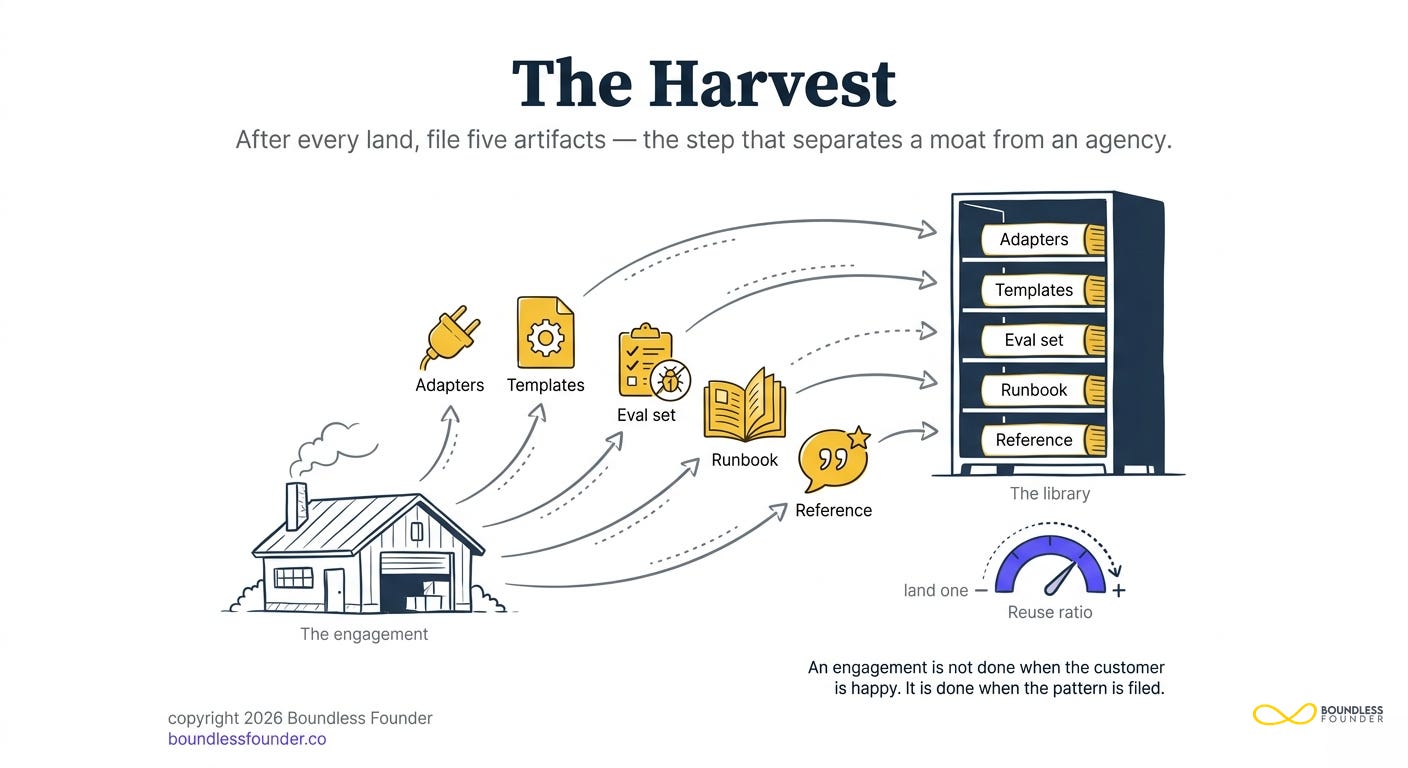
Then measure the only metric this framework asks you to track: the reuse ratio — roughly, how much of this build came from the library versus from scratch. It'll be near zero on land one; that's fine, that's what land one is for. My working heuristic — and I'll flag honestly that it's a heuristic from running and watching embedded engagements, not a published statistic — is that by your third land in the same segment, the majority of the build should be assembly rather than invention. If the ratio isn't rising, you're not running Land-Harvest-Compound. You're running Land-Land-Land, and that's an agency with a nicer name.
One corollary rule, because it's where the discipline actually bites: no new segment until the current one is harvested. The temptation after a win is to chase whoever shows up next — a logistics firm today, a dental group tomorrow, a law office Friday. Every one of those is a land with a reuse ratio of zero. Depth first: exhaust the segment where your patterns already work, and open a new one deliberately, not because an inbound email flattered you.
Compound: sell the pattern, not the hours
Now the loop pays. The second land in the same segment is a different animal from the first — and the difference is the entire business model.
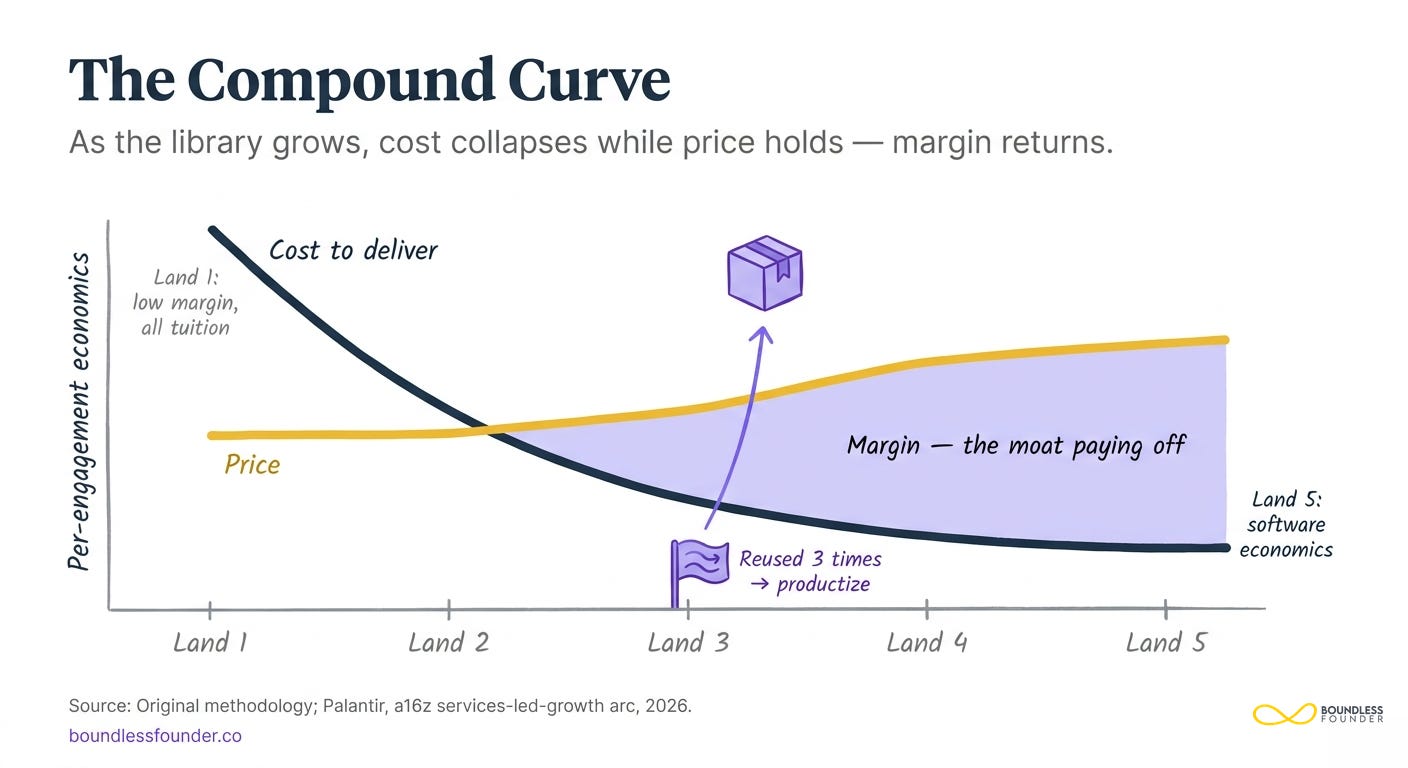
Your cost collapses: the adapters exist, the templates exist, the eval set catches the edge cases before the customer does, the runbook turns setup from exploration into a checklist. The ten-day sprint becomes five, then three. Your win rate jumps: you walk in with a named reference from their industry peer and a working pattern instead of a promise — you're no longer selling effort, you're selling a result that already exists one building over. And your price holds or rises while cost falls, because the customer is paying for the outcome, not your hours — they don't get a discount because you got faster. That spread — price holding while cost collapses — is margin returning, and it's the exact arc a16z documents in services-led startups that pass $20 million in ARR inside two years: low-margin and services-heavy at the start, software economics emerging as the pattern library does more of the work.
Run the brokerage thread one more step and watch the distribution physics from Part 1 turn mechanical. Land two is the brokerage across town: the AMS adapter already exists, the eval set already speaks their dialect of mess, and the reference comes from a peer they golf with — because tight vertical segments talk to themselves through associations, peer groups, and poached producers. You didn't build a sales channel; the segment's own social graph is carrying your reference for you. That's what "a channel that gets easier as you scale" looks like from the inside: land one was cold outreach, land four is an inbound email that starts with "I heard you're the one who fixed…"
This is also when pricing graduates. The flat-fee sprint was right for land one, when neither side could predict the result. Once the pattern is proven and the outcome is predictable, price the outcome: per workflow deployed, per seat, per resolution. Sierra is the north star here — $100 million in ARR in under two years charging only when its agent resolves the customer's problem. You earn the right to price like that exactly when your eval set and runbook make the outcome boring. Outcome pricing on land one is gambling; outcome pricing on land five is arithmetic.
And compounding is when the product appears — not from a roadmap offsite, but from the library. My rule of three: anything you've reused three times gets productized — hardened, documented, self-serveable. Palantir's software was its harvested field learning; your product is whatever your segment made you build three times. By then it arrives pre-validated (three customers run it in production), pre-differentiated (it encodes edge cases only deployment could surface), and pre-distributed (the references and workflow embeds from Part 1 — the moat is the workflow, and you're already in it).
The rule of three cuts the other way too, and the second edge matters more. Anything reused once stays in the library as parts, not product. Productizing after a single deployment is how you end up polishing a feature for a market of one — the same premature-generalization mistake as the segment-of-one customer, wearing a roadmap. Let the segment vote three times before you believe it.
The guardrails: what to refuse
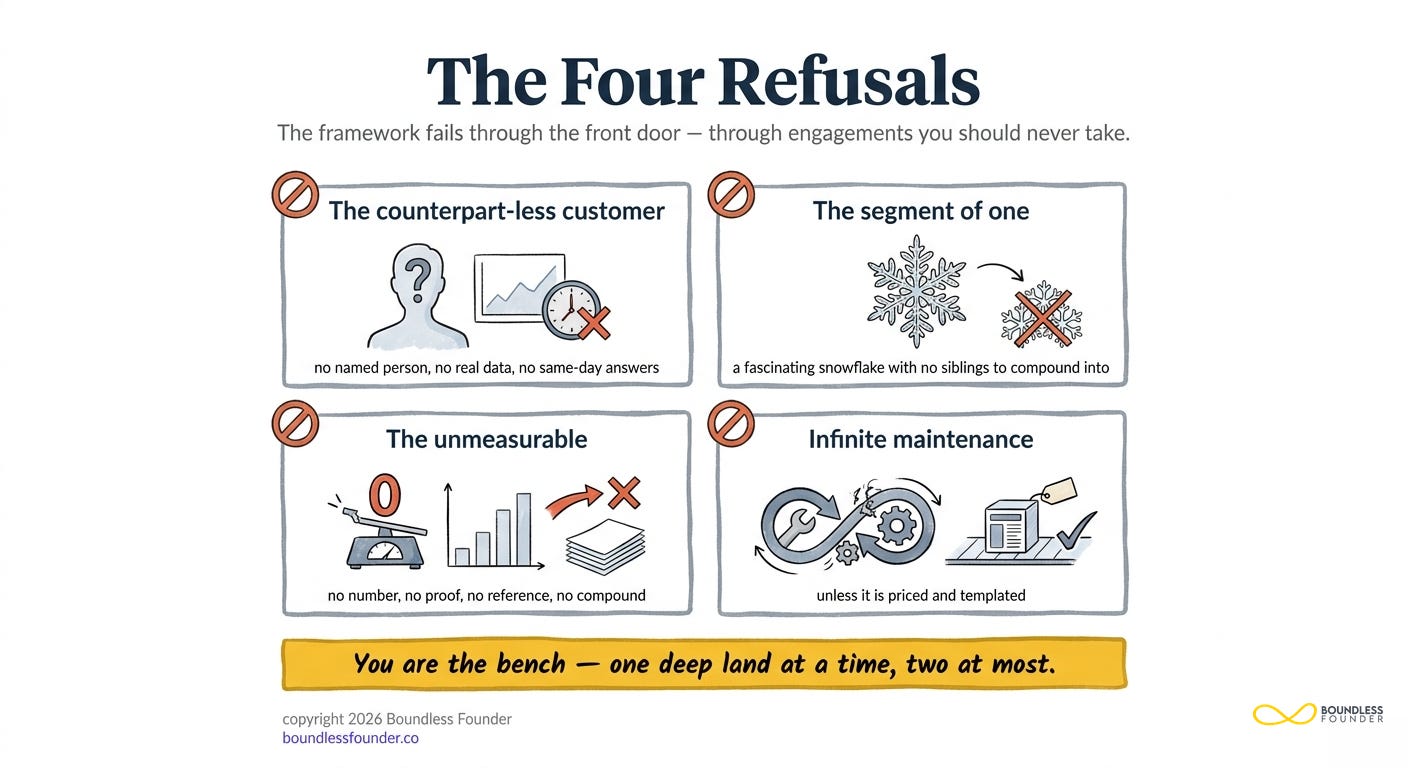
The framework fails through the front door — through engagements you should never have taken. Four refusals protect it.
Refuse the counterpart-less customer. No named person, no real data, no same-day answers — no deal, whatever they'll pay. A land without a counterpart produces no harvest, and per the law, an engagement that can't be harvested is billing, not building. (It's telling that in the giants' own hiring, customer-facing discovery is the most-demanded FDE skill — the counterpart conversation is the job.)
Refuse the segment of one. The fascinating snowflake customer with a workflow nobody else has: flattering, lucrative, and a compounding dead end. Take it only if you're consciously billing it as an agency gig to fund the real motion — and be honest with yourself about which one you're running.
Refuse the unmeasurable. No number, no proof; no proof, no reference; no reference, no compound. "Make our ops smoother" is not a land. "Cut ticket resolution time" is.
Refuse infinite maintenance — unless it's priced and templated. The quiet agency-maker isn't the build; it's the aftermath. Bespoke babysitting for every past customer eats the calendar that compounding needs. The runbook exists so support is cheap; a small monthly retainer priced from the runbook is fine (it's recurring revenue and a standing reference). Unpriced, untemplated "quick favors" forever are not.
Behind all four sits the capacity rule: you are the bench. One deep land at a time — two at absolute most — plus light-touch follow-ups. The giants cap their pods too; scarcity discipline isn't a small-company weakness, it's how everyone who runs this motion protects quality. Which is also the honest limit of this framework: it doesn't scale headcount, it scales assets. That's the point.
The pod: what AI actually does in this loop
The title of this piece promises a framework for a team of one, so let me be mechanical about where the "team" comes from. In the giants' version, a deployment pod is five or six specialists. In yours, it's you plus a frontier model, and the division of labor is specific — not "AI helps," but particular jobs at particular steps.
In the land, AI is the reconnaissance unit. The historical cost of forward deployment was senior engineers spending weeks understanding an unfamiliar environment before building anything. That's now the model's best event: feed it the customer's exports, API documentation, screen recordings, and your counterpart's answers, and it produces the system map, the integration plan, and the first scaffold in an afternoon. This is the cost collapse from Part 1 doing its work — the part of the engagement that was expensive is the part AI absorbs.
In the build, AI is the implementation bench. You direct; it writes the adapters, drafts the workflow logic, and turns each edge case you hit into a handled case. Your job in the room during days three through seven is closer to a director's than a coder's: deciding what matters, catching what the customer actually meant, keeping scope honest.
In the harvest, AI is the librarian — and this is the one that saves the framework. The honest reason founders skip the harvest ritual isn't ignorance; it's exhaustion: day ten arrives and writing runbooks feels optional. So delegate it. The model that just spent a week inside the build can parameterize the templates, draft the runbook from your working transcript, and extract the eval cases from everything that went wrong — in an hour, for review rather than authorship. The half-day ritual becomes a half-day of editing, and the "no time to harvest" excuse dies. If Part 1's claim was that AI made the deployment cheap, the quieter corollary is that it made the discipline cheap too.
What stays human is exactly what the market says is scarce. Recall the hiring data: more than 70% of forward-deployed job postings list customer-facing discovery as the core requirement — sitting with a stakeholder, decomposing a vague mess into a buildable thing, earning the trust that makes the counterpart tell you what's actually broken. That's your job, undelegated. The pod writes code; the founder is forward-deployed.
Your first sprint: the ten-day version
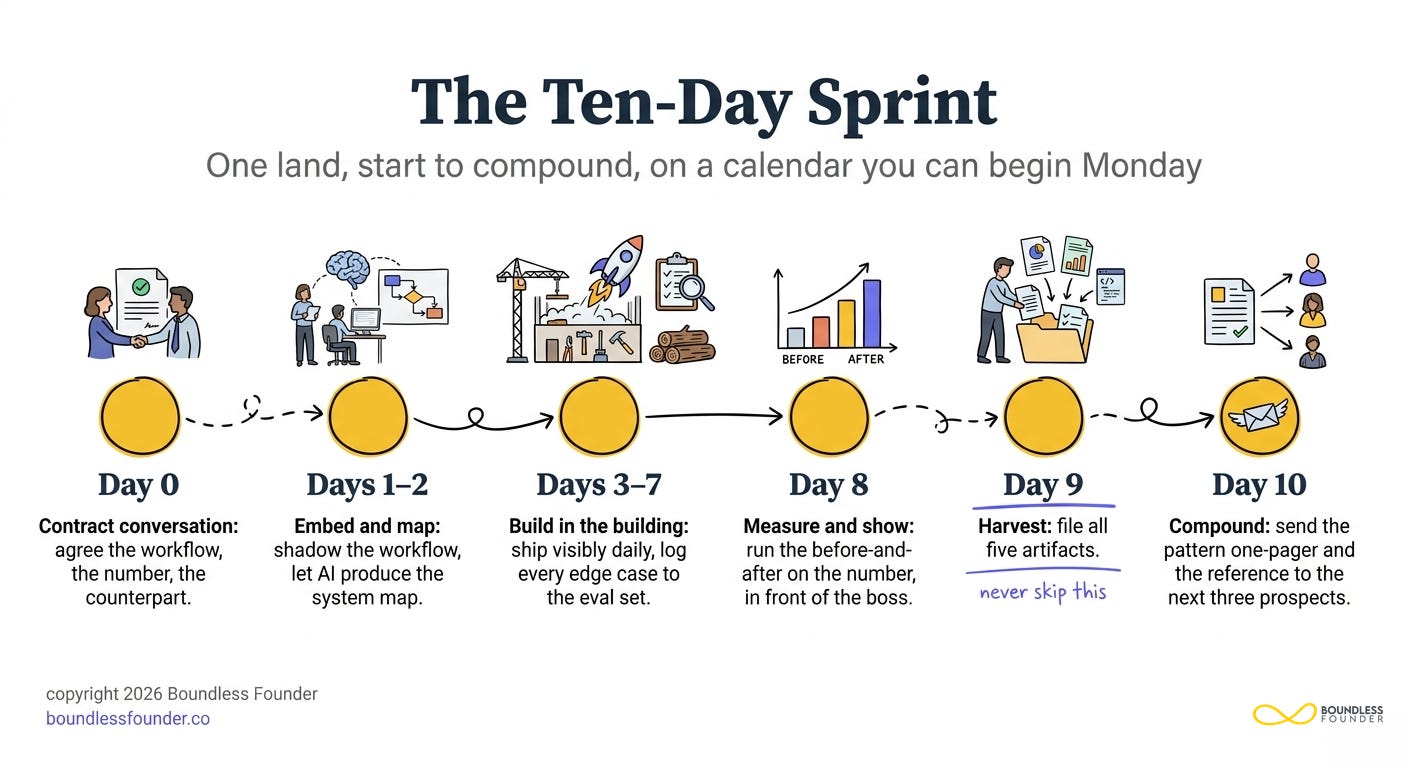
Everything above, compressed into a calendar you can start Monday. This assumes the pre-work is done: you've picked a segment, listed ten candidate customers in it, and sent the one-sentence offer to three of them. One said yes at $5K flat.
Day 0 — the contract conversation. One call. Agree the workflow, the number (write it down: current value, target, who measures it), the counterpart, the access you need on day one, and the definition of done. Send a one-page summary. This page is half your runbook already.
Days 1–2 — embed and map. Shadow the workflow live — watch a person actually do the thing, in their tools, with their data. Then do the AI reconnaissance: feed everything legible (exports, API docs, screen recordings, the counterpart's answers) to your model of choice and produce the system map and integration plan. This mapping used to be the expensive first two weeks of an enterprise engagement; it's now a founder-plus-AI afternoon, and it's the single biggest reason this framework is newly possible.
Days 3–7 — build in the building. Ship something visible daily, however small, into their environment — visible daily progress is what keeps the counterpart engaged and the trust compounding. Every edge case their real data throws at you goes straight into the eval set as it happens (trying to remember them at the end doesn't work; I've tried). By day seven, the workflow runs end-to-end on real data.
Day 8 — measure and show. Run the before/after on the agreed number, in front of the counterpart and — push for this — their boss. Don't demo features; report the number. If it moved, this meeting produces your reference. If it didn't, this meeting produces the honest diagnosis, and that's worth a land too (a documented "why this pattern fails here" saves you from repeating a doomed land at full cost — file it and move on).
Day 9 — harvest. The half-day ritual, all five artifacts: adapters, templates, eval set, runbook, reference. Not optional, not deferrable, not "after I answer these emails."
Day 10 — compound. Write the pattern one-pager (what it does, the number it moves, proof, price) and send it — with the reference — to the next three candidates on your segment list. Price land two higher. You now sell a result, not an experiment.
Run that loop for ninety days and the checkpoint looks like this: three or four lands in one segment, a library where most of a new build is assembly, at least two named references, a price that's risen every land, and a shortlist of what's crossed the rule of three and wants to become product. That's not an agency and it's not a pre-product startup burning toward a demo day. It's a compounding machine that happens to be cash-flow positive.
The law, one more time
Land is where you earn the learning. Harvest is where you keep it. Compound is where it pays. And underneath the whole loop, the one sentence to tape above your desk: every engagement must make the next one cheaper — otherwise you're billing, not building.
Where am I wrong? I'm specifically curious about the harvest step — if you're running deployments today, tell me what your version of the five artifacts looks like, and where the ritual breaks for you in practice. Reply and tell me; the sharpest answers will shape the rest of this series.
Next in the series: Ship Into the Building — why forward deployment is the fastest way to build the right product, and the antidote to the synthetic-validation trap: real workflows, real data, real edge cases, while your competitors A/B-test a landing page against an imagined customer.
This is Part 2 of The Forward-Deployed Founder, a series inside The AI-Native Founder. Part 1: Forward-Deployed Everything. It builds on You're Validating the Wrong Thing.
Part 3 — Ship Into the Building — is next.