
Forward-Deployed Everything: The $9 Billion Signal Hiding in Plain Sight
The giants just spent $9B putting engineers inside customers. Founders can now run the same motion for almost nothing — and it's the cheapest moat left to build.

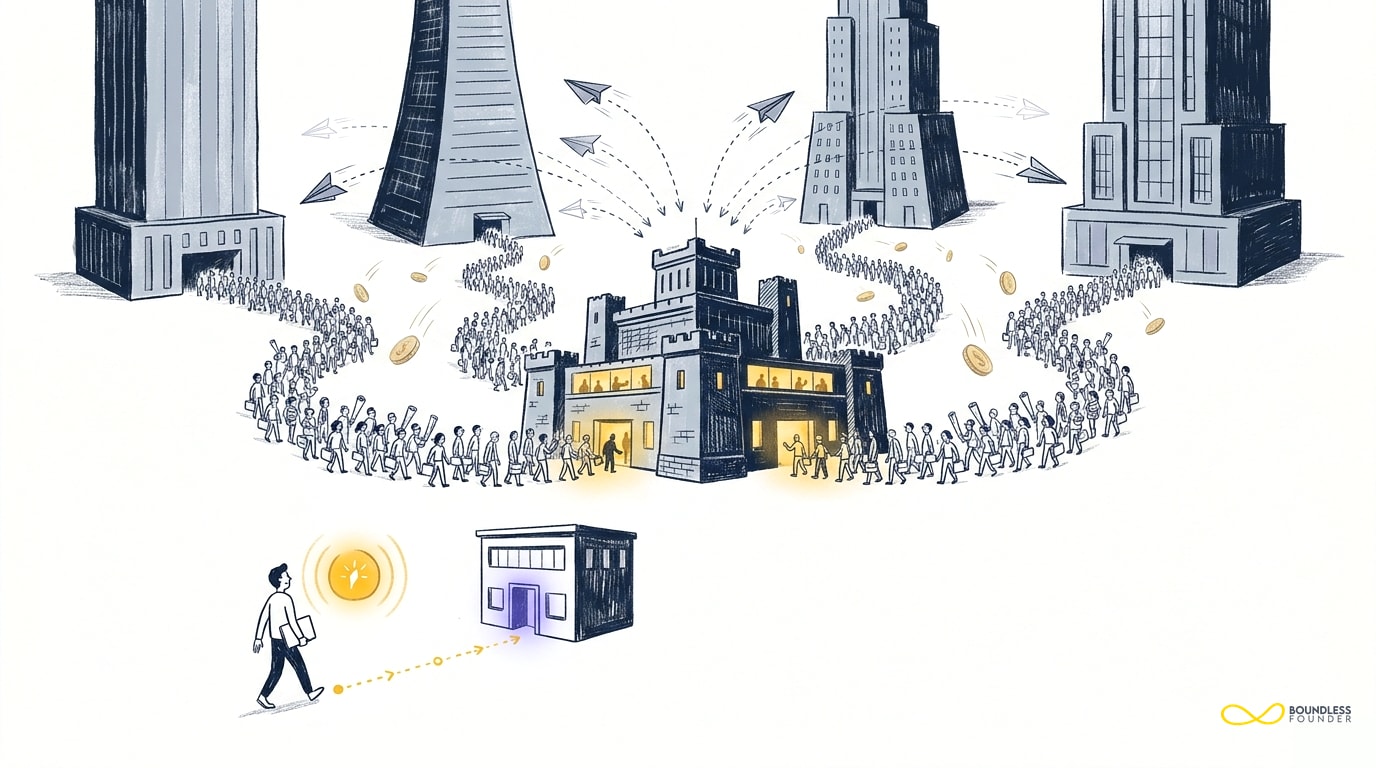
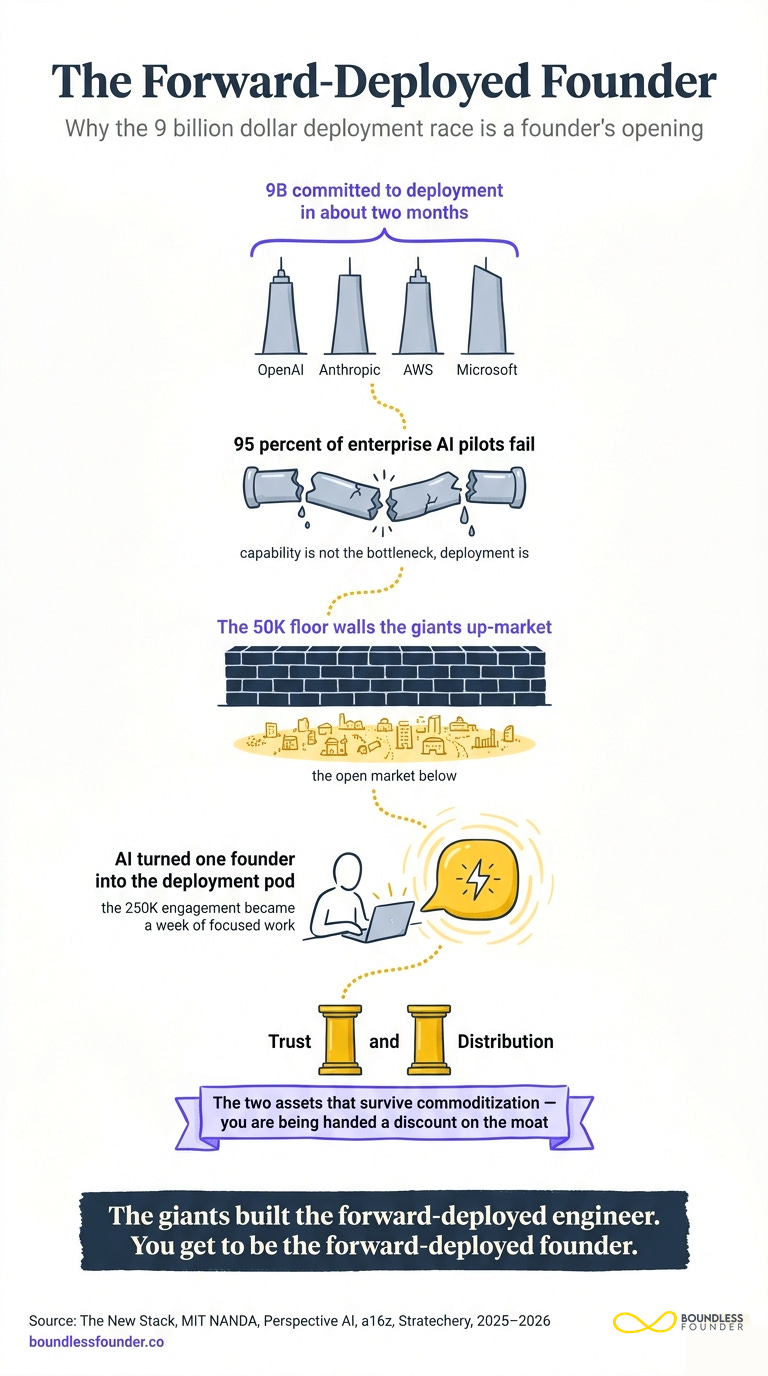
In the space of two months, four AI giants committed roughly $9 billion — not to better models, but to putting human engineers inside their customers' buildings. That's the loudest signal of the year for founders. The motion they're paying billions to build, you can now run for almost nothing — and it's the cheapest way left to build the two things that survive when AI commoditizes everything else: a customer's trust, and a distribution moat.
Over roughly two months this year, the four most valuable companies in AI all did the same strange thing, one after another.
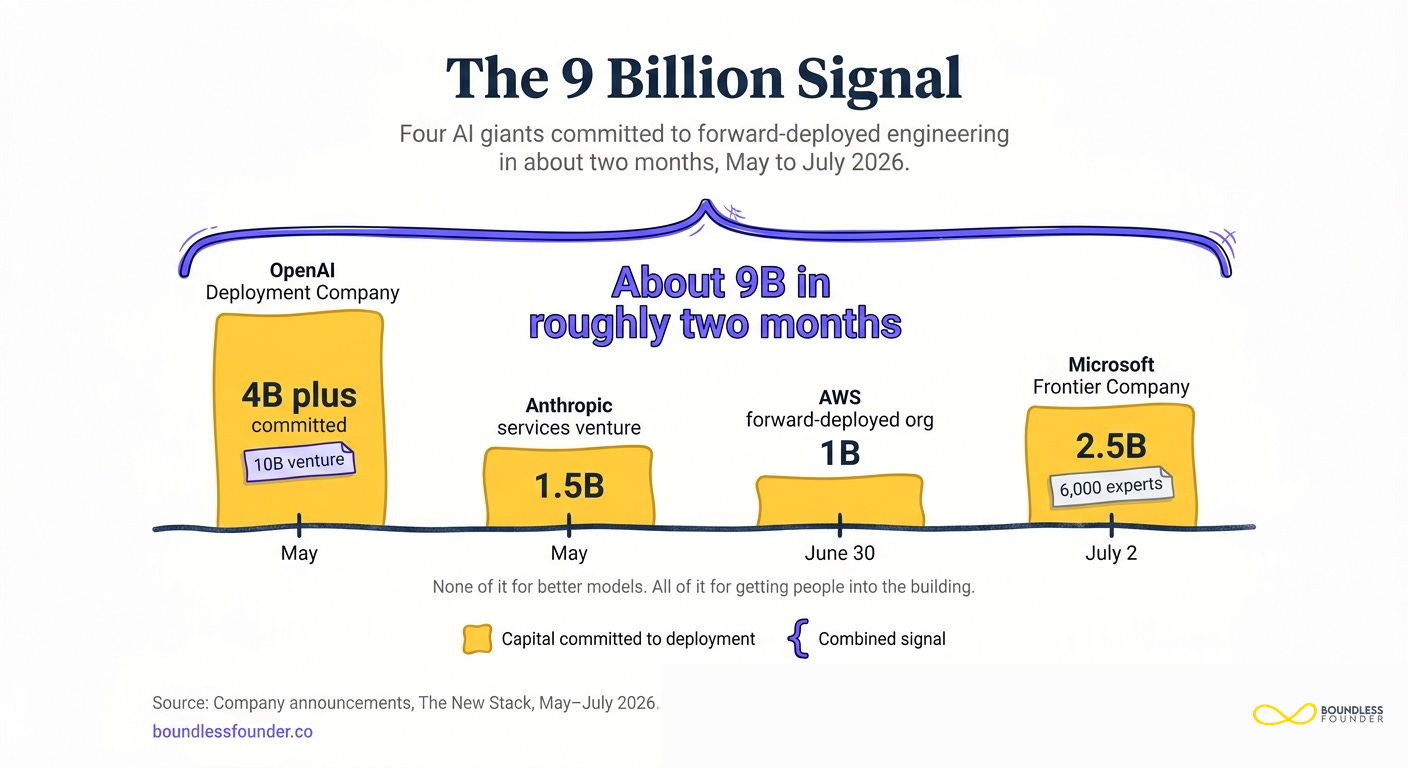
OpenAI stood up a separate company — literally a new entity — to send engineers into customers' offices. Anthropic did a version of the same with a $1.5 billion venture. AWS committed a billion dollars to an organization whose entire job is to embed small squads of engineers inside a client for a few weeks at a time. And Microsoft closed the run with a $2.5 billion unit staffed with six thousand people.
Add it up and you get close to $9 billion, committed in the space of about two months, by companies that are supposedly in the business of making software so smart it doesn't need humans in the room.
That's the part worth sitting with. These are the companies whose whole pitch is automation. Their models write code, answer support tickets, and pass the bar exam. And their response to the biggest question in their industry — why isn't all this capability turning into revenue? — was to hire armies of humans and put them on planes.
They didn't spend the money on better models. They spent it on getting people into the building. It's the clearest admission yet of where the real bottleneck in AI has moved. And once you see where it moved, you'll see something the $9 billion isn't built to capture — an opening that belongs to founders, not incumbents. It happens to be the cheapest way left to build the only two assets that survive when the technology underneath everyone commoditizes at once: a customer's trust, and a distribution channel that compounds. That's the real prize hiding inside the signal, and it's what this piece is about.
The $9 billion nobody's explaining right
Let me lay out what actually happened, because the individual announcements got covered and the pattern didn't.
OpenAI launched what it calls the Deployment Company — DeployCo — backed by a roster of private-equity heavyweights: TPG leading, with Advent International, Bain Capital, and Brookfield as co-lead founding partners. The venture is valued at $10 billion and majority-owned by OpenAI, and it launched with more than $4 billion of committed capital. The job isn't research. The job is walking into an enterprise and making the AI actually work.
Anthropic did its own version in May — a roughly $1.5 billion venture with Blackstone, Hellman & Friedman, and Goldman Sachs, pointed at midsize businesses and private-equity portfolios that want Claude deployed, not just licensed.
Then AWS, on June 30, committed $1 billion to a forward-deployed engineering org of its own. The model, as it's been reported publicly: pods of five or six engineers embed with a client for roughly 45-day cycles, priced on the outcome rather than by the billable hour.
And two days later — the last of the four — Microsoft's commercial chief Judson Althoff announced the Microsoft Frontier Company: $2.5 billion, six thousand "industry and engineering experts" who will sit inside customer organizations to design, deploy, and run AI systems.
Four companies. Two months. One idea. As The New Stack put it, the giants are "spending billions — and not on better models." TechXplore was blunter: they're deploying "engineer armies to help make AI profitable."
Here's the question that unlocks the whole thing: why would the companies with the best models on earth spend $9 billion on the least glamorous thing in software — services?
The answer is a number I've written about before, and it hasn't gotten less brutal. MIT's NANDA report found that 95% of enterprise generative-AI pilots fail to deliver measurable return. Not because the models are bad. The models are extraordinary. They fail in the last mile — the messy, unglamorous work of getting a brilliant model to survive contact with a real company's data, workflows, compliance rules, and legacy systems.
That's the tell. Capability stopped being the scarce resource. Deployment became it. The models leapt ahead of everyone's ability to actually use them, and $9 billion is what it looks like when the smartest companies in the industry admit that the gap between "the demo works" and "it's running in production and someone's paying for it" is now the whole game.
The name for the people who close that gap is forward-deployed engineers. And the reason the term is suddenly everywhere is that the entire industry just reorganized around them.
The job that ate AI
If you want to know where an industry thinks its value has moved, don't read the press releases. Look at who it's fighting over hiring.
By that measure, the forward-deployed engineer is the most important person in AI right now. Job postings for the role are up somewhere between 800% and 1,000% year over year, depending on whose data you trust. On Indeed, postings reportedly went from 643 in April 2025 to more than 5,300 a year later — a roughly 729% jump. By several external counts it's now the fastest-growing job title in AI in the United States.
The money follows. A 2026 survey of 1,500 forward-deployed engineers put median total comp for a senior FDE at a frontier lab around $485,000, with staff-level roles clearing $725,000 and principals passing a million. That's not what you pay for a support function. That's what you pay for the people you believe are the actual product.
And notice who's doing the hiring. Palantir — the company that invented this motion twenty years ago — is the highest-volume hirer, followed by OpenAI, Anthropic, Google, Databricks, Scale. The most sophisticated AI companies alive are competing hardest for the humans who sit with the customer.
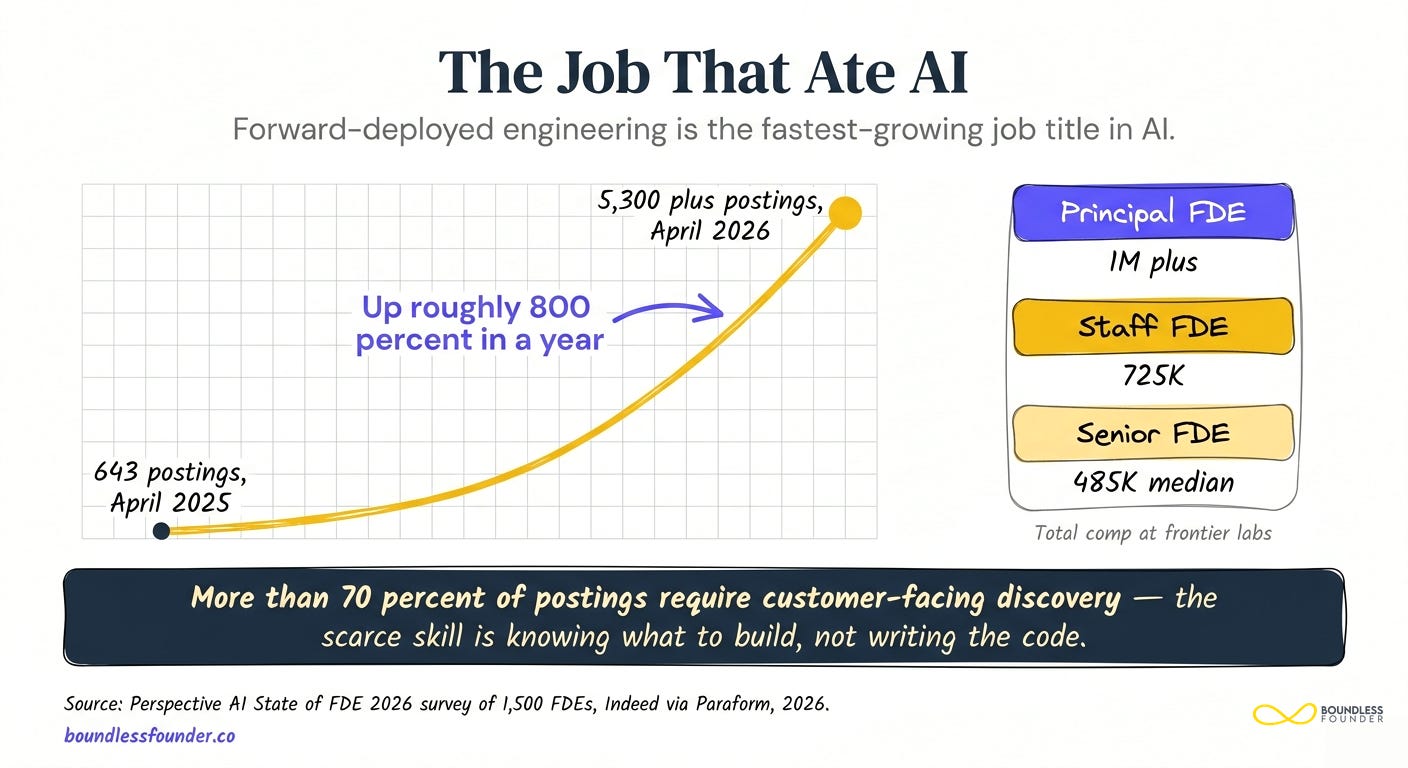
The most revealing detail in that survey isn't the salaries. It's what the job actually requires. More than 70% of recent postings list "customer-facing discovery" as a core requirement — the ability to sit across from a stakeholder, decompose a vague business problem, and translate it into something you can ship. The scarce skill isn't writing the code. Writing code is the part AI already does. The scarce skill is understanding what to build, inside a real company, from a conversation.
That detail is the crack the rest of this article walks through. The most valuable AI companies on earth are pouring billions into a job whose hardest part is not the engineering. It's the being-there. It's the judgment about what matters to this specific customer, in this specific workflow, that you can only get by being in the room.
That is not a capability you buy with a bigger model. It's a capability you earn by showing up. Which is exactly why it's worth $9 billion — and exactly why it's available to you.
Born in startups, scaled by giants, aimed away from you
Here's the history that almost nobody tells correctly, and it changes what the $9 billion means.
Forward deployment wasn't invented by the labs. It was born in a startup. Palantir spent two decades building its entire company around the idea that you don't sell software to a hard customer — you send your best engineers to live inside the customer's problem, build the thing with them, and only later turn what you learned into product. a16z has a name for what happened next: the "Palantirization of everything." The whole industry copied the motion.
What made it work — and what critics missed for years while they wrote Palantir off as a consulting shop in a software costume — is the second half. The engineers weren't in the building to bill hours. They were there to find the patterns. Every deployment taught the company something reusable about how this kind of customer's problem actually looked, and that learning got folded back into the product, so the next deployment was faster, and the one after that faster still. The people were the sensor. The product was the business. Hold onto that two-part structure — sensor and business, wedge and moat — because it's the exact thing that separates the founders this series is written for from the ones who'll spend three years accidentally running an agency.
And when the labs built their versions, they built them out of startups. OpenAI didn't grow its forward-deployed muscle organically — it acquired Tomoro, a London firm built on the motion, to bring 150 forward-deployed engineers into DeployCo from day one. The pattern was born small and scaled up, not the other way around.
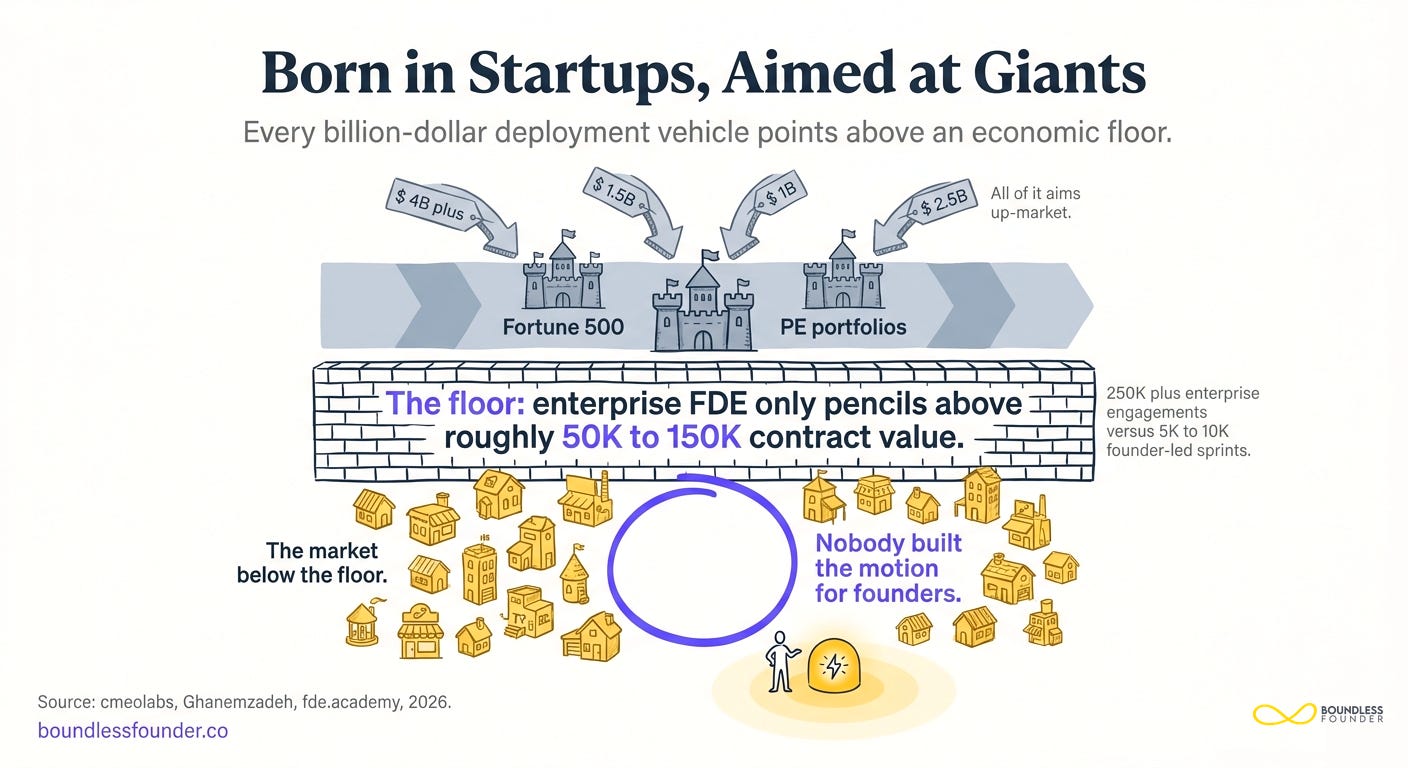
Which makes what happened next a little strange. Every one of those billion-dollar vehicles points in exactly one direction: up-market. DeployCo, the Anthropic venture, Microsoft Frontier, the AWS org — all of them are aimed at the Fortune 500 and the private-equity portfolios that aggregate the mid-market. Not one of them is built for a startup customer.
That's not an oversight. It's economics. Independent analyses of forward-deployed engagements converge on a hard floor: the model only pencils above roughly $50,000–$150,000 of annual contract value, and it inverts below that. One practitioner describes the market splitting into two sizes this year: an enterprise version at $250K+ with quarter-long procurement, and a scrappy founder-led version at $5–10K run in ten-day sprints. Frontier-lab pricing only clears at enterprise scale. If you're a founder, the giants' version of this motion was never going to be sold to you. The math doesn't work.
So there's a genuine white space here: nobody spent a billion dollars building the forward-deployed motion for founders. And your instinct might be to read that as a gap someone should fill — a product, a service, a thing to go buy.
It isn't. Because founders don't need anyone to build this motion for them. The reason it cost $250,000 a deployment just collapsed.
Why this is suddenly your motion
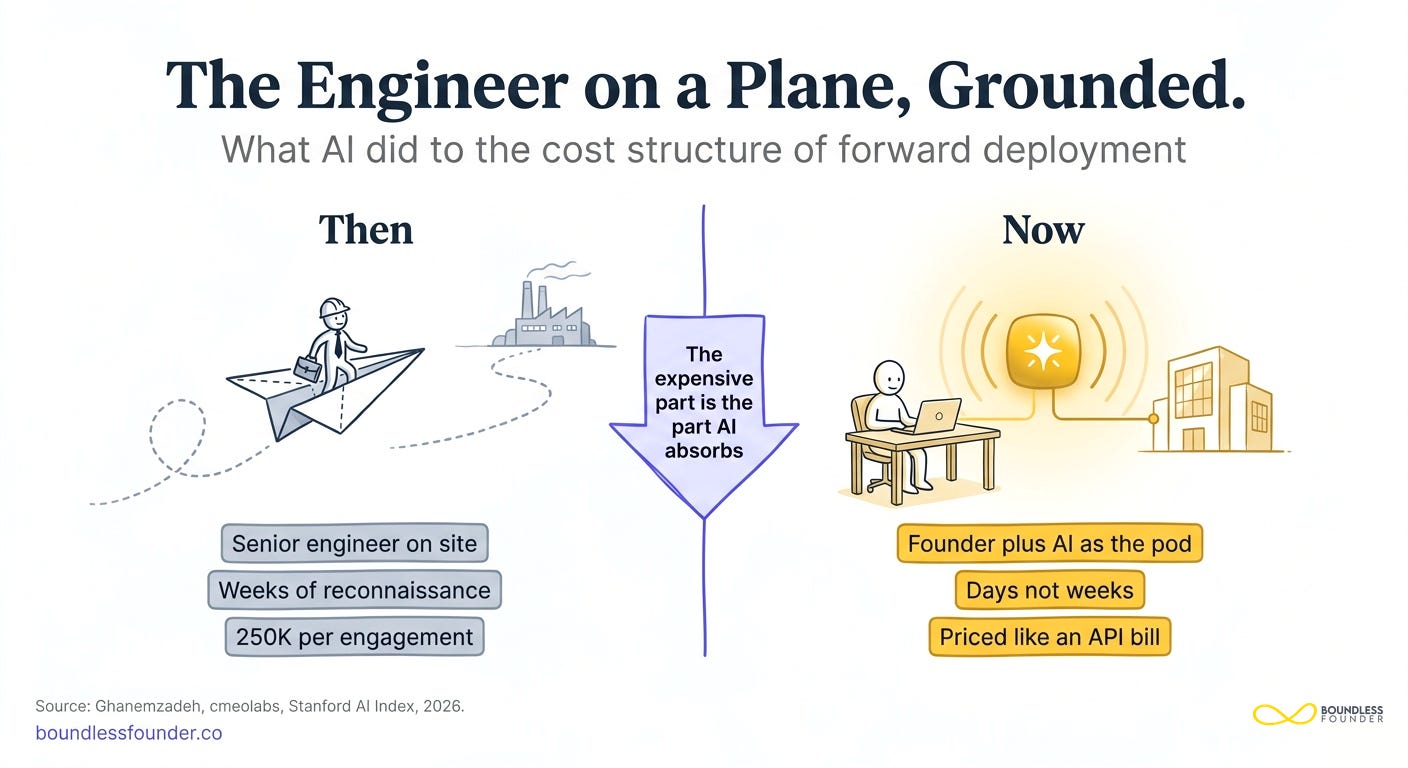
Ask why forward deployment was ever expensive, and the answer is specific. It took a senior engineer — one of your best, most expensive people — physically on-site, for weeks, hand-building a bespoke integration into a system they'd never seen before. The whole cost structure was one metaphor: the engineer on a plane. Senior, scarce, slow, and billed accordingly.
Now look at what AI did to every single input in that sentence.
The senior engineer's rarest skill — reading an unfamiliar codebase, mapping a workflow, writing the integration — is the exact thing today's models do best. I've spent the past two years around embedded AI engagements, and this is the change I can testify to firsthand: the reconnaissance that used to eat the opening weeks of a deployment — understand their system, trace their workflow, scaffold the glue code — is now a day or two of work for one founder with Claude or GPT in the loop. The build that justified a $250,000 engagement is compressing into a week of focused work. Not because the problems got easier, but because the part of the work that was expensive — senior engineering hours against an unfamiliar system — is the part AI absorbs.
I keep coming back to an irony I wrote about in my last article. The 280x drop in inference costs and the collapse of the gap between open and closed models — the thing that's quietly killing your feature moat — is the same force that just turned you into a one-person forward-deployed pod. The commoditization that makes your clever AI feature easy for anyone to copy is the commoditization that lets you walk into a customer's mess and rebuild their workflow in a week. It cuts both ways. Most founders only feel the blade.
Here's the asymmetry, stated precisely — because the sloppy version of this claim is wrong. A two-person startup doesn't out-deploy Microsoft's six thousand experts, and it doesn't need to. Remember the floor: the giants' cost structure makes any engagement below roughly $50K in contract value uneconomic to touch. That floor works like a wall, and they're on the other side of it. Every deal beneath it — the mid-market company with a $30K problem, the niche workflow too small for a Frontier pod, the customer segment that will never see a DeployCo engineer — belongs to whoever can deploy profitably down there. AI just took your cost of deploying there to nearly zero. The same economics that wall you out of their market wall them out of yours — and yours just became enormous.
I don't think founders have internalized this yet. We spent two years anxious that AI would commoditize us out of a moat. The overlooked half of the story is that AI also handed us the one motion that used to be reserved for the most capitalized companies in the world. The giants spent two decades and $9 billion building the forward-deployed engineer. What just became possible is something they can't hire: the forward-deployed founder — the person who runs the motion themselves, from day one, with AI as the pod.
The two things that survive
Cheap only matters if the thing you can now afford is worth owning. So before showing you what this motion looks like in practice, step back and ask what actually lasts in this market — because it's the real reason the moment matters.
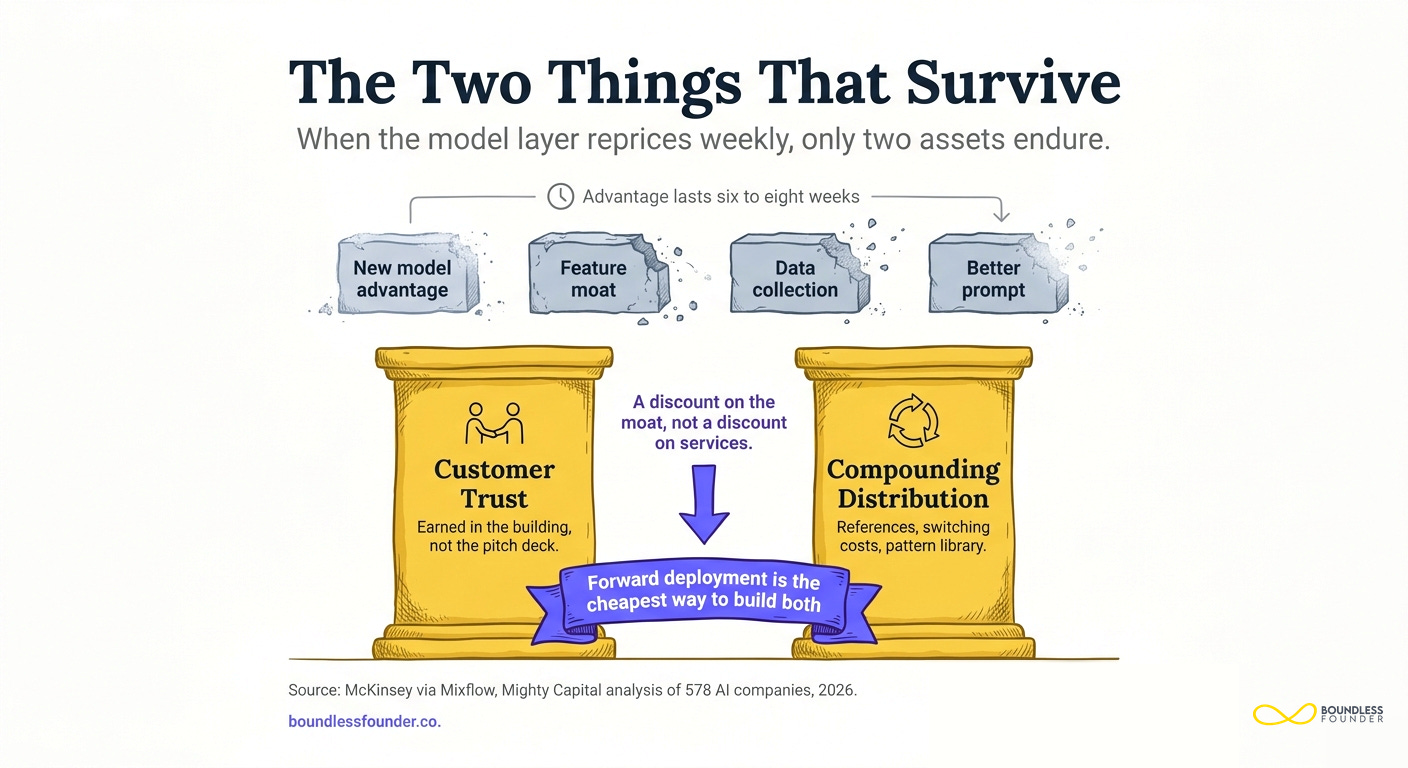
I spent the last article making the case that features don't last. McKinsey's read is that the competitive advantage from adopting a new AI model lasts six to eight weeks before everyone else has it too. Mighty Capital ranked the moats of 578 funded AI companies and put feature moats dead last, with data moats barely above them. When the model layer reprices every week, anything you built on top of it that a competitor can also build on top of it isn't a moat. It's a head start with a short shelf life.
Two things don't commoditize. A customer's trust in you. And a distribution channel that gets stronger every time you use it. Neither can be open-sourced, downloaded, or matched with a better model. And forward deployment is the cheapest way anyone has found to manufacture both.
Start with trust, because it's the one founders most underestimate. There's a difference in kind between a customer who watched your demo and a customer whose actual workflow you rebuilt — sitting in their office, shipping fixes to their weird edge cases in real time, making a number they care about move. The first is a prospect. The second is a relationship, and it's one a competitor with a better model still has to earn from zero. You cannot demo your way to that. You can only deploy your way to it. Underneath everything, the $9 billion the giants are spending is a bet that trust in AI is manufactured in the building, not in the pitch deck.
Then distribution, which is where it compounds. Every forward-deployed build does three things at once. It embeds you deeper into the customer's workflow — Sequoia's line is "your moat is your workflow; don't build tools, build outcomes" — which becomes a switching cost a feature never could. It produces a reference: a named customer, a real result, a story the next prospect's peer will vouch for. And it feeds a pattern library, so your second deployment in a vertical is faster and cheaper than your first, and your fifth is faster still. That is the definition of a distribution channel that compounds — the exact "distribution defensibility" I told you last time was the thing actually worth validating. A cold-outbound motion gets harder as you scale. A forward-deployed motion gets easier, because every deployment leaves behind trust, a reference, and reusable assets that lower the cost of winning the next one.
So here's the real reason the moment is unusual. It isn't just that a motion that used to cost $250,000 a deployment now costs a founder an API bill. It's that the newly-cheap motion happens to be the cheapest way left to build the only two assets that survive when the technology underneath everyone commoditizes at once. You're not being handed a discount on services. You're being handed a discount on the moat.
What it looks like when someone runs it
So what does manufacturing trust at deployment speed look like in practice? You don't have to imagine it. It's already happening in public, and the clearest example isn't a scrappy seed-stage team — it's a company that ran the motion so well it makes the point impossible to miss.
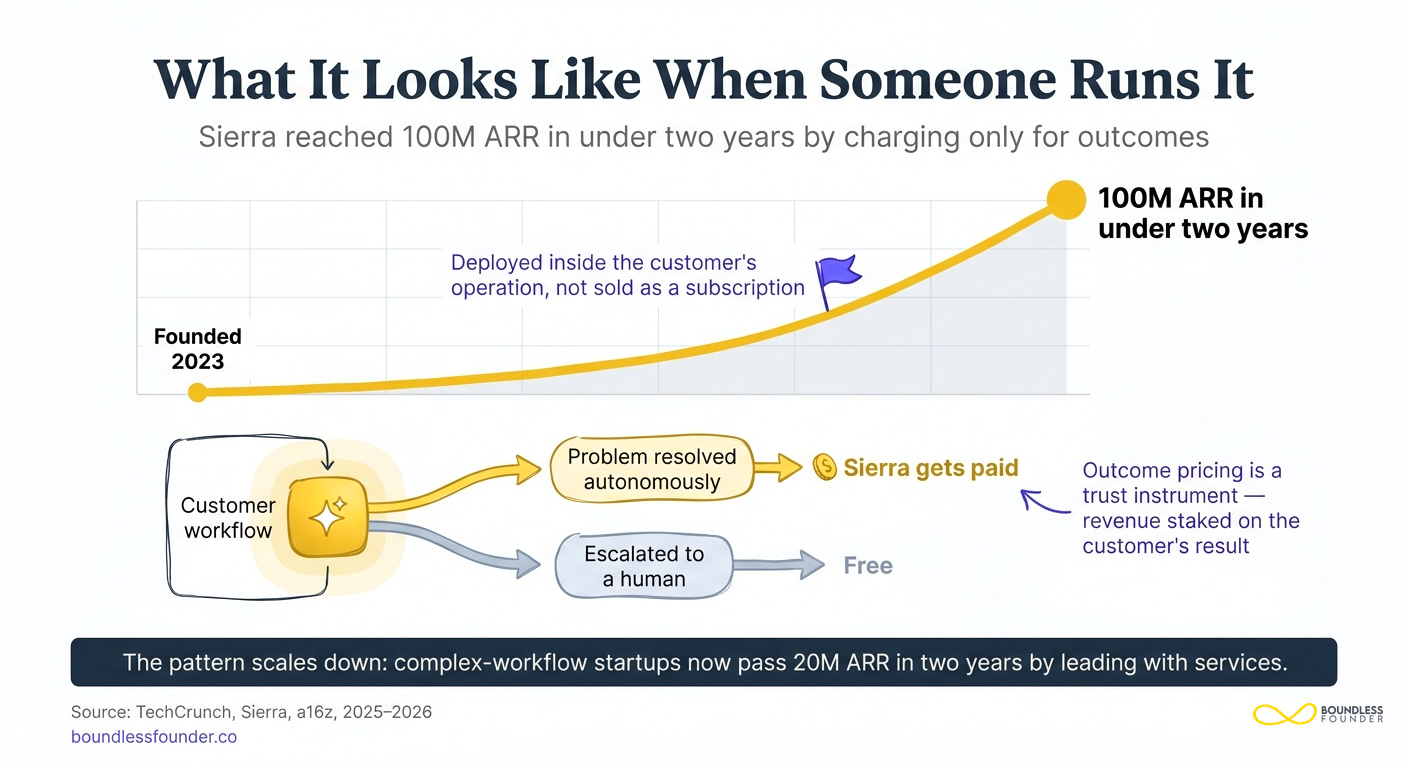
Sierra, the customer-experience AI company co-founded by former Salesforce co-CEO — and current OpenAI board chair — Bret Taylor, reached $100 million in annual recurring revenue in under two years. That's not the interesting part. The interesting part is how. Sierra doesn't sell a subscription to software. It deploys agents into a company's actual customer operations and charges only when the agent resolves a customer's problem on its own—pay-per-resolution. If the agent has to hand off to a human, the interaction is free.
Taylor has a line about why that structure matters: the atomic unit of AI productivity, he argues, isn't a person — it's a process. You're not selling seats. You're selling an outcome inside the customer's workflow. And you can only price an outcome if you're deployed deeply enough to be responsible for it — which means you have to be in the workflow, not next to it. Outcome-based pricing and forward deployment turn out to be the same idea wearing two hats: you can't credibly charge for a result you're not embedded enough to deliver. This makes that pricing model a trust instrument as much as a revenue model—it tells the customer, "We're so embedded in your outcome that we'll stake our revenue on it." That's the trust argument from the last section, converted into a contract.
Sierra is a well-funded company with a famous founder, so it's fair to ask whether the motion scales down. The a16z data says it does, and further than you'd think. Enterprise-software startups tackling genuinely complex workflows are now regularly going from zero to $5 million, $10 million, past $20 million in ARR in their first two years by leading with exactly this — putting technically skilled people directly into customers during early adoption, nailing the hard implementation, and letting the contracts follow. The forward-deployed engineer is, in a16z's own phrasing, the hottest job in startups, not just in labs.
Here's the quiet version of the same thing, and it's the one that matters most for you: a lot of founders are already running this motion without naming it. The solo founder who lands their first three customers by personally rebuilding each one's workflow over a weekend, camping in their Slack, shipping fixes in real time — that founder is running a forward-deployed motion. They just think of it as "doing whatever it takes to get to yes." What this series argues is that the whatever-it-takes scramble isn't a phase to grow out of. Done with discipline, it is the strategy. The giants just stapled a $9 billion price tag onto the thing you were already doing for free and told you it's the most valuable motion in enterprise AI.
Forbes called the forward-deployed engineer the most expensive job in enterprise. For a founder with AI in the loop, it might be the cheapest edge you have.
Why now — and why the window closes
You could reasonably ask: if this is so obviously available, why hasn't everyone done it? Two reasons, and they're the same reasons the window is real but temporary.
The first is that the whole industry spent the last three years pointed the other way. The default startup instinct in the AI era has been to build the product, put up a signup page, demo it, and hope. That's the SaaS playbook, and it's a good one — for a world where building was the hard part. But building isn't the hard part anymore. When the technology layer commoditizes in days, a demo proves almost nothing, and "we built it" is table stakes rather than an achievement. The value moved to the things forward deployment produces — a system running in the customer's real environment, a relationship, a workflow you're now embedded in. Most founders are still optimizing for the part that got easy.
The second reason is that the motion feels backward. Leading with services — trading clean software margins for the grind of being in the customer's building — reads like the opposite of a scalable startup. It looks like becoming a consultancy. Founders have been trained to run from exactly this.
Both reasons are exactly why the moment exists — a real opening is always something that works before it feels respectable. But here's the objection I'd raise against my own argument: if a16z has already published the playbook and job postings are up 800%, isn't the window closed? Look closer at who's running the motion, and when. The version going mainstream is the hiring trend — growth-stage startups adding forward-deployed teams at Series B and beyond, once there's revenue to justify the salaries. The survey data says roughly 43% of forward-deployed engineers already work inside startups — but as employees, hired after product-market fit, at companies that can afford them. What is not yet standard is the version this series is about: the founder running the motion personally, from day one, with AI as the pod, before there's anyone to hire. That's the actual window. It doesn't close when people notice forward deployment — it's been noticed. It closes as running-it-yourself becomes the default founding playbook. The compounding head start — the early references, the reusable patterns, the trust — goes to the founders who start while it still feels counterintuitive.
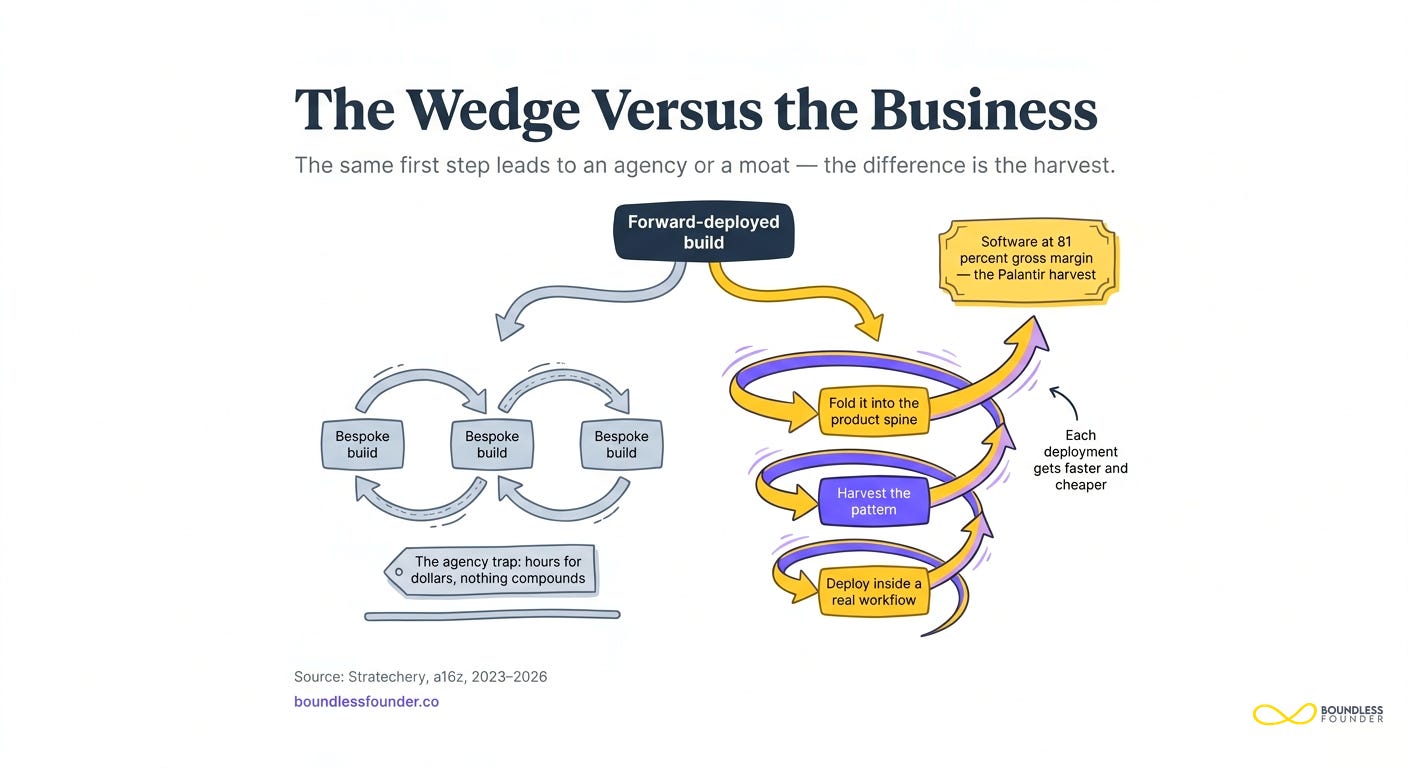
I want to be honest about the trap, though, because it's a real one and the same a16z essay is refreshingly blunt about it. If you copy only the embedded-engineer part — if you take the "get in the building" lesson and stop there — you end up with thousands of bespoke, unmaintainable deployments and no moat at all. You become an agency: busy, cash-flow-positive, and permanently stuck trading hours for dollars. Forward deployment without a product spine isn't a moat. It's a job.
So this is not an argument for becoming a consultancy. It's an argument for using deployment as the wedge — the way you get inside a real problem and learn what's actually worth building — and then doing the disciplined work of harvesting each engagement into product. Palantir didn't stay a services company. It priced the field work near cost and harvested it into software running at roughly 81% gross margins. The services were the wedge. The software was the business. That distinction — wedge versus business — is the entire ballgame, and it's what the rest of this series is about.
What this series is going to do
I've spent a lot of time close to how large companies actually buy and deploy AI, and the thing that strikes me most is the gap between that reality and the advice founders get. Founders are told to build fast, launch, and iterate. Meanwhile the companies with the most money and the best models concluded that the winning move is to slow down, get in the room, and build with the customer. Someone should translate what the giants are spending $9 billion to learn into something a founder with no budget can actually run on Monday.
That's this series. This first piece was the why — the moment, and the two assets it exists to build. The next three parts are the how.
Next, the framework — how to run a forward-deployed motion as a founder without drowning in bespoke work. I'll take the enterprise playbook the giants use, strip out the parts that only make sense at Fortune 500 scale, and lay out a version built for a team of one or two: how you pick the first customer, ship the wedge, and — the step that separates a moat from an agency — harvest each build into a reusable product spine.
Then, why it's the fastest way to build the right product. Forward deployment is the antidote to the synthetic-validation trap I described last time. You stop asking an AI to imagine your customer and start building inside your customer's actual workflow, with their real data and their real edge cases — the 20% that never shows up in a demo and is the only part that's defensible.
And finally, why it's the new go-to-market. Leading with a forward-deployed build is how a seed-stage startup lands deals the demo-and-hope motion can't touch — and how you trade some early margin, deliberately, for the compounding trust and distribution this piece was about.
You don't have to wait for the framework to feel what this motion changes, though. Here's an experiment you can run this week. Pick one prospect you'd normally send a demo, and offer this instead: give me your ugliest workflow and one week — I'll rebuild it, working, in your environment, for a flat price, and you keep what I build either way. That's the founder-sized version of the engagement practitioners already price at $5–10K. Whatever they answer, notice how different the conversation becomes when the ask is watch it work on your problem instead of evaluate my product. That difference, felt firsthand, is the whole thesis of this series.
The $9 billion is a signal, not a strategy. The strategy is what you do with the fact that the most valuable companies in AI just told you, with their checkbooks, where the value actually is — and then aimed all of it at customers you're not competing for, using a motion you can now run cheaper than they can.
Where am I wrong about this? I'm especially curious whether you're already running a forward-deployed motion without calling it that — landing customers by building with them instead of selling to them — and what's working or breaking when you do. Reply and tell me. I read everything, and the sharpest pushback tends to reshape where this series goes next.
This is Part 1 of The Forward-Deployed Founder, a series inside The AI-Native Founder. It builds on You're Validating the Wrong Thing and AI Didn't Just Change What We Build.*
Part 2 — Land, Harvest, Compound: the forward-deployed framework for a team of one — is next.
If you're a fo
under building with AI and want to compare notes on running this motion, reply with what you're building and where you're stuck.